




Back

Implementing screening and brief intervention for substance use in primary care in rural Georgia

Substance use disorders (SUD) pose a global public health challenge, yet evidence-based interventions like Screening and Brief Intervention (SBI) remain underutilized in primary care, particularly in low- and – middle-income countries, such as Georgia. Despite strong evidence supporting SBI’s effectiveness, major implementation gaps persist. These challenges hinder SBI delivery and leave vulnerable populations underserved, as is the case in the context of rural Georgian communities. This K43 Emerging Global Leader application seeks to address these barriers and bridge the SBI implementation gap through innovative, scalable interventions.

Georgia provides a valuable setting to study SBI implementation in a health system with limited integration of behavioral health and distinct structural barriers to care. Despite these contextual differences, many of the core challenges – such as time constraints, stigma, and limited referral capacity – are also present in U.S. settings, particularly in rural and underserved American communities. By identifying effective implementation strategies across contexts, this study will generate generalizable knowledge to improve delivery of evidence-based cost-effective substance use interventions in U.S. primary care, benefiting the health of Americans.

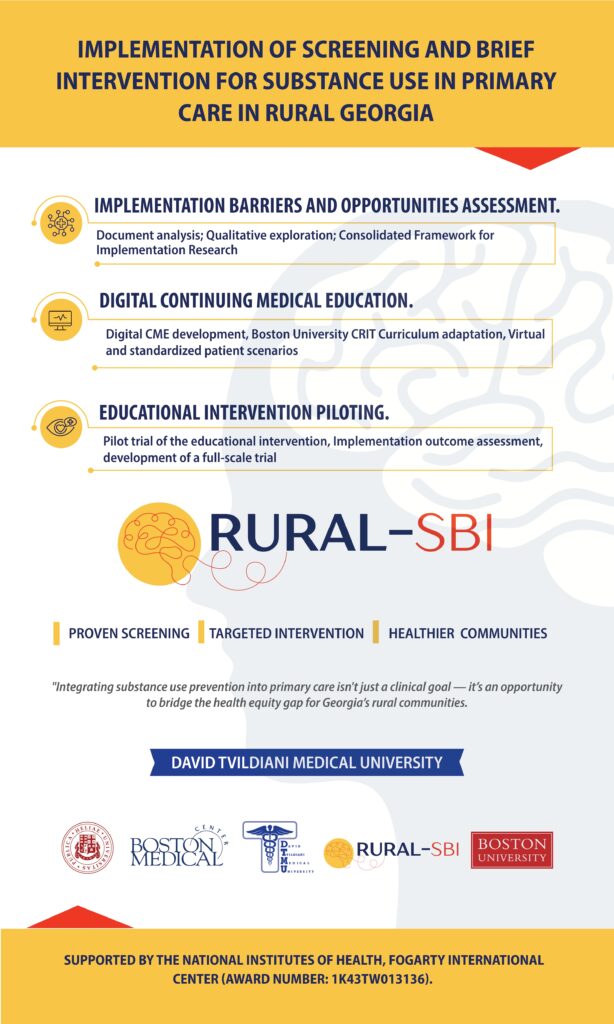
The study aims to identify individual, environmental, and systemic barriers to SBI implementation in rural Georgian primary care and address these barriers through a tailored educational intervention. Using frameworks such as the Implementation Outcomes Framework, the SBIRT Program Matrix, and the Consolidated Framework for Implementation Research, the project will (1) assess contextual barriers and facilitators to SBI implementation in rural primary care (Aim 1), (2) develop a culturally tailored online educational intervention promoting SBI using virtual patient scenarios and problem-based learning cases (Aim 2), and (3) pilot test the intervention to assess its feasibility and inform a future community-level implementation randomized controlled trial (RCT). Innovation: This study leverages a combination of multiple implementation science frameworks to provide a comprehensive and systematic approach to identifying and addressing SBI implementation gaps. Its unique focus is to address SBI implementation in rural settings through a culturally adapted online continuing medical education (e-CME) program. The intervention will provide an innovative model for improving SBI adoption in resource-limited contexts, contributing to the global evidence base on scalable solutions for SUDs.

Supported by National Institutes of Health, Fogarty International Center, USA. Award number: K43TW013136

Implementing screening and brief intervention for substance use in primary care in rural Georgia

In Georgia, as in many countries around the world, the use of alcohol and other substances has a significant impact on population health. These problems are often not identified in a timely manner, especially at the level of primary care – that is, the first point of contact when a person seeks medical attention.
Primary care physicians (family doctors, rural clinic staff) have a unique opportunity to detect risks early, discuss alcohol, tobacco, and other substance use with patients, and offer simple but effective interventions. However, in practice this does not always happen, which may be due to limited time, lack of appropriate training, systemic barriers, stigma, and cultural factors.
The aim of this project is to analyze these challenges and develop solutions that can realistically work within the context of rural primary care in Georgia.
The study uses an approach known as Screening and Brief Intervention (SBI). During screening, the physician asks a patient several standardized questions to assess alcohol or other substance use, frequency of use, and level of risk. If the patient is identified as being at risk, the physician provides a brief (5–10 minute) counseling session, explains the risks, gives recommendations, and helps motivate behavioral change. This method is low-cost, easy to implement, and has been shown in international research to be effective.
The project is based on clearly defined Specific Aims, which include: examining existing practices and challenges at the primary care level, particularly in the management of non-communicable diseases and risk behaviors (e.g., alcohol and drug use); identifying the experiences and needs of patients and healthcare professionals; and developing and pilot a context-adapted, implementable digital educational intervention based on the evidence generated. These aims ensure that the research is practically applicable and directly contributes to improving the health system.
The study will examine how physicians perceive this approach, what barriers prevent its use, what facilitates its implementation, how patients respond, what educational resources and approaches are needed, and what systemic changes are required. Within the study, educational materials will be developed for rural physicians, and relevant training will be provided.
The project will use both qualitative and quantitative research methods. The focus is on people’s experiences, opinions, and attitudes, as well as the needs of the Georgian population.
The study will assess existing practice and the working environment through interviews with physicians and field visits, as well as consultations with employers, professional associations, and governmental structures. During field visits, we will observe how and in what settings patient consultations take place and how clinical practice is supported and strengthened.
The study is an implementation science project. This field examines how to translate effective ideas and methods into real-world practice—that is, not only “what works,” but also how to implement it, under what conditions it works, and how to adapt it to a specific country.
This project will use a structured theoretic frameworks that enable systematic analysis of organizational context, human factors, healthcare governance, and resources.
The project is fully aligned with Georgia’s national health priorities and strategic directions, as it contributes simultaneously to the development of the healthcare workforce, improvement of physicians’ professional qualifications, and strengthening of continuing professional education. In addition, the project aims to strengthen the primary care system by ensuring high-quality, patient-centered, and integrated services. Special attention is given to the prevention of non-communicable diseases and reduction of related risk factors, including alcohol and drug use, as well as the strengthening of mental health support, which is fully consistent with the country’s long-term health policy and action plans.

Summary:

This project is an important step toward strengthening primary care, equipping physicians with effective tools, and ensuring that patients receive timely and appropriate medical care.
The study aims not only to describe the problem but also to create real-world solutions that will be implemented in practice and benefit the population of Georgia.

Innovation:

This study introduces a novel, scalable approach to implementing Screening and Brief Intervention (SBI) in rural primary care in Georgia through a digitally delivered, culturally tailored continuing medical education (CME) intervention. It develops an interactive online training program using virtual patient simulations designed specifically for rural healthcare providers. While digital and simulation-based SBI training remains underutilized in low-resource and rural settings, this project addresses a key gap in implementation strategies for substance use interventions in primary care.
Unlike conventional CME, the intervention integrates culturally adapted virtual patient scenarios into a flexible online format tailored to rural clinicians’ needs and constraints. This approach reduces logistical barriers, increases engagement, and enhances the feasibility of SBI delivery in routine practice. By leveraging Georgia’s emerging telemedicine infrastructure, the intervention is designed to be scalable, cost-effective, and sustainable for underserved areas.
A key innovation is the use of a combined implementation science framework approach, integrating the Implementation Outcomes Framework (IOF) with the Consolidated Framework for Implementation Research (CFIR) to examine multi-level determinants of SBI adoption. This enables a comprehensive analysis of individual, organizational, and system-level factors to optimize implementation.
Finally, culturally tailored CME modules will be developed based on qualitative input from primary care providers and health system stakeholders, incorporating local language, clinical scenarios, and context-specific examples. This enhances relevance, acceptability, and potential for sustained implementation in Georgia and similar low-resource settings.

About the Fogarty Emerging Global Leader Award:

The purpose of these grants is to provide research funding and protected time for investigators from low- and middle-income countries (LMICs) who hold academic positions in their home institutions. The overall goal of the NIH Research Career Development Program is to ensure a highly skilled scientific workforce in biomedical, behavioral, and clinical research fields. The National Institutes of Health and its institutes support career development programs that promote the transition of new investigators toward independence and assist experienced investigators in achieving specific scientific goals.
The NIH K43 award is a hybrid mechanism that combines research implementation with structured support for the investigator’s career development.
The career development component of this project aims to strengthen knowledge and skills in implementation science, qualitative and mixed-methods research, and the design and evaluation of interventions in primary care systems. Planned activities include intensive mentorship, participation in specialized courses and trainings, and hands-on experience in research design, data collection, and analysis. The candidate will receive continuous mentorship support from multidisciplinary and international experts, which will facilitate the development of grant writing, scientific leadership, and dissemination skills. These activities will ensure the development of an independent investigator and sustainable capacity to conduct high-quality, locally relevant research in Georgia.
Project Team


The project team brings together expertise in implementation science, primary care, substance use interventions, medical education, and global health systems strengthening.
The project is based at David Tvildiani Medical University, and brings together experts from Boston University School of Medicine, Boston, MA, and Ilia State University, Tbilisi, Georgia.

Principal Investigator
Dr. Ilia Nadareishvili, MD, PhD

David Tvildiani Medical University, Tbilisi, Georgia
Dr. Nadareishvili is a physician–scientist specializing in implementation science, primary care systems, and substance use interventions. He will lead all aspects of the project, including study design, implementation, data collection, analysis, and dissemination. He will also lead the development of digital CME intervention and coordinate collaboration between international and local partners.

Primary US Mentor
Professor Jeffrey Samet, MD, MA, MPH

Boston University School of Medicine / Boston Medical Center, USA
Dr. Samet is a leading expert in addiction medicine and primary care-based substance use interventions. He is a pioneer in the development and implementation of SBIRT (Screening, Brief Intervention, and Referral to Treatment) in primary care settings. He will provide senior mentorship on study design, implementation science methodology, and dissemination strategies. He has mentored dozens of successful researchers from the US and abroad, including six NIDA INVEST fellows, and 16 NIH K awardees. His mentorship has been acknowledged with several awards.

Primary Georgian Mentor
Professor Nino Tabagari, MD, PhD

David Tvildiani Medical University, Tbilisi, Georgia
Dr. Nino Tabagari, Dean of AIETI Medical School, David Tvildiani Medical University; director of the Medical Education Center in Tbilisi, Georgia. Dr. Tabagari is an experienced internal medicine physician, biomedical and medical education researcher. A medical education expert, Dr. Tabagari has focused her work on educational innovations. She will advise and support virtual patient case development, adaptation of the CRIT curriculum, and the intervention delivery. She oversees responsible conduct of research and provides daily guidance on study participant enrollment and retention.


Co-Mentors / Advisory Team
Karsten Lunze, MD, MPH, DrPH


Boston University School of Medicine / Boston Medical Center, USA
Dr. Lunze is an expert in implementation science, addiction research, and global health. He has extensive experience in study design, quantitative and mixed-methods research, and development of implementation frameworks in low- and middle-income country settings. As Honorary Professor at David Tvildiani Medical University, he maintains ongoing engagement with DTMU and contributes to training and mentorship activities.

Irma Kirtadze, MD, PhD


Ilia State University, School of Arts and Sciences, Tbilisi, Georgia
Dr. Kirtadze is a leading expert in substance use and addiction research and MPI of the Fogarty/NIDA D43-funded Georgian Implementation Science Fogarty Training Program (GIFT), which supports the development of implementation science capacity in Georgia. She has extensive experience in addiction research methodologies, instrument development, data quality assurance, and statistical analysis. Her role will focus on substance use prevention and treatment research, community engagement, responsible conduct of research (RCR), and grant management. She also supports project dissemination, including opportunities for collaboration and exposure through the GIFT network.

David Otiashvili, MD, PhD


Ilia State University, School of Natural Sciences and Medicine, Tbilisi, Georgia
Dr. Otiashvili is a leading addiction researcher in Georgia with extensive experience in substance use policy and implementation research. He has co-led projects resulting in government-approved SBIRT and ASSIST guidelines and has strong collaboration networks with primary care providers in Georgia. He contributes expertise on implementation of the study within the Georgian health system and policy context, and supports integration of research findings into national practice and policy.

Daniel Alford, MD, MPH


Boston University School of Medicine / Boston Medical Center, USA
Dr. Alford is Professor and Associate Dean of Continuing Medical Education at Boston University School of Medicine and a pioneer in CME-based addiction training interventions, including the CRIT program. He will provide mentorship on CME intervention design, didactic development, validation of assessment tools, and implementation of SBI in primary care settings.

Advisors
Veriko Mirtskhulava, MD, PhD

Ilia State University, School of Natural Sciences and Medicine, Tbilisi, Georgia
Dr. Mirtskhulava is a researcher and educator specializing in epidemiology, biostatistics, and survey methodology. She has expertise in instrument validation, data management, and applied biostatistics training in medical education settings.

Local Implementation Team (Georgia)
Mariam Beridze, MPH

Ms. Beridze is a public health specialist with experience in health systems strengthening, digital health, and implementation of telemedicine initiatives in Georgia. She has worked with national and international organizations, including WHO Country Office in Georgia, contributing to projects focused on digital health transformation, rural healthcare access, and health system interoperability. Her expertise includes public health research, qualitative and quantitative methods, and program implementation in resource-limited settings.

Mariami Jojua, MD

Dr. Jojua is a medical doctor with clinical and research interests in mental health and the integration of mental health services into primary care. She is particularly interested in implementation science approaches to improving access to evidence-based mental health care in resource-limited and rural settings in Georgia.